Thank you! Your submission has been received


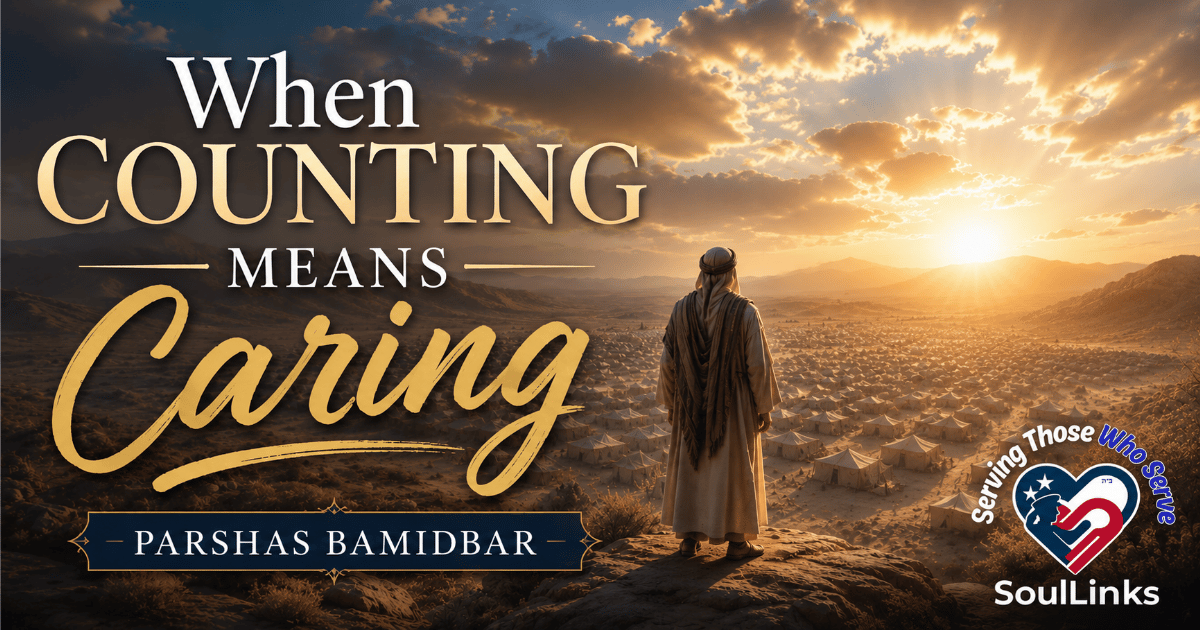
There are moments in life when people begin to feel invisible.
A police officer working another overnight shift.
A soldier standing watch in silence.
A first responder running from call to call.
A struggling student sitting quietly in the back of the room.
A grieving parent trying to keep functioning.
A volunteer wondering whether anyone notices their sacrifices.
And then comes this week’s Torah portion: Parshas Bamidbar.
At first glance, it appears technical and administrative. The Torah describes a census of the Jewish people in the desert:
שְׂאוּ אֶת־רֹאשׁ כָּל־עֲדַת בְּנֵי־יִשְׂרָאֵל
“Take a census of the entire assembly of the Children of Israel…”
- Bamidbar 1:2
But the commentators explain something remarkable.
The Torah does not use the ordinary language of counting. Instead, it says:
שְׂאוּ אֶת־רֹאשׁ
Literally: “Lift up the head.”
This phrasing was intentional. The Torah was not merely conducting a tally. It emphasized the importance of each individual, ensuring every member of the nation knew they mattered.
In Judaism, counting people is not merely a statistical exercise.
It is relational.
And the Torah continues:
בְּמִסְפַּר שֵׁמוֹת
“By the number of their names.”
- Bamidbar 1:2
The census was conducted “by name.”
Not anonymously.
Not as numbers.
But as individuals.
Every person mattered.
Every family mattered.
Every soul mattered.
Even the Torah’s language for a census reflects the idea of elevating each individual. The Torah was not simply tallying bodies. It was recognizing souls.
The Torah was not simply counting bodies.
It was affirming dignity.
Recognizing identity.
Elevating human beings.
The desert generation was preparing for an uncertain journey ahead. There would be challenges, conflict, instability, fear, and responsibility. And before the nation could move forward through the uncertainty of the desert, G-d first reminded them:
You are not anonymous.
You are known.
You matter.
That message may be even more relevant today than ever before.
We live in a world obsessed with metrics:
followers, numbers, rankings, budgets, productivity, analytics, statistics.
Organizations often measure output more than humanity.
Society measures visibility more than character.
Yet the Torah begins Bamidbar with something radically different:
Before the mission comes recognition.
Before movement comes identity.
Before leadership comes learning how to truly see people.
The Lubavitcher Rebbe often emphasized that genuine leadership means recognizing the unique mission and dignity of every individual. A healthy community is not built when everyone becomes identical; it is built when every person understands that their unique contribution matters.
That idea appears immediately in Bamidbar.
The tribes each had distinct identities, responsibilities, flags, and positions within the camp. Unity did not erase individuality. It elevated it.
And perhaps that is one of the great spiritual lessons of the desert.
A desert can feel empty. Isolated. Harsh.
People sometimes go through emotional deserts, too:
periods of burnout, loneliness, uncertainty, grief, or exhaustion.
But Bamidbar teaches that even in the wilderness, every person still counts.
Especially there.
At SoulLinks, this lesson resonates deeply with our mission of “Serving Those Who Serve.”
Many of the people we encounter in chaplaincy and community work are individuals who spend their lives taking care of everyone else:
law enforcement officers, military personnel, dispatchers, medics, chaplains, veterans, caregivers, volunteers, and community leaders.
Strong people are often the ones least likely to ask for help.
And sometimes the most meaningful thing you can do for another human being is not to solve every problem immediately but to genuinely recognize them.
To see them.
To remind them that they matter beyond their title, badge, rank, or productivity.
The Torah’s census was conducted “by name.”
Not by barcode.
Not by category.
Not by algorithm.
By name.
Because every soul carries infinite dignity.
And maybe that is the challenge of Bamidbar for all of us this week:
Who around us has begun to feel unseen?
A spouse?
A child?
A coworker?
A responder?
A volunteer?
A parent?
A grieving friend?
Who needs encouragement?
Who needs acknowledgment?
Who simply needs someone to notice them?
Sometimes one sincere conversation can change a person’s entire emotional direction.
Sometimes one message of appreciation can keep someone going.
Sometimes being counted means being cared for.
In a noisy world that constantly reduces people to statistics, the Torah quietly reminds us:
בְּמִסְפַּר שֵׁמוֹת
Every person has a name.
People are not numbers.
They are souls.
And every soul matters.