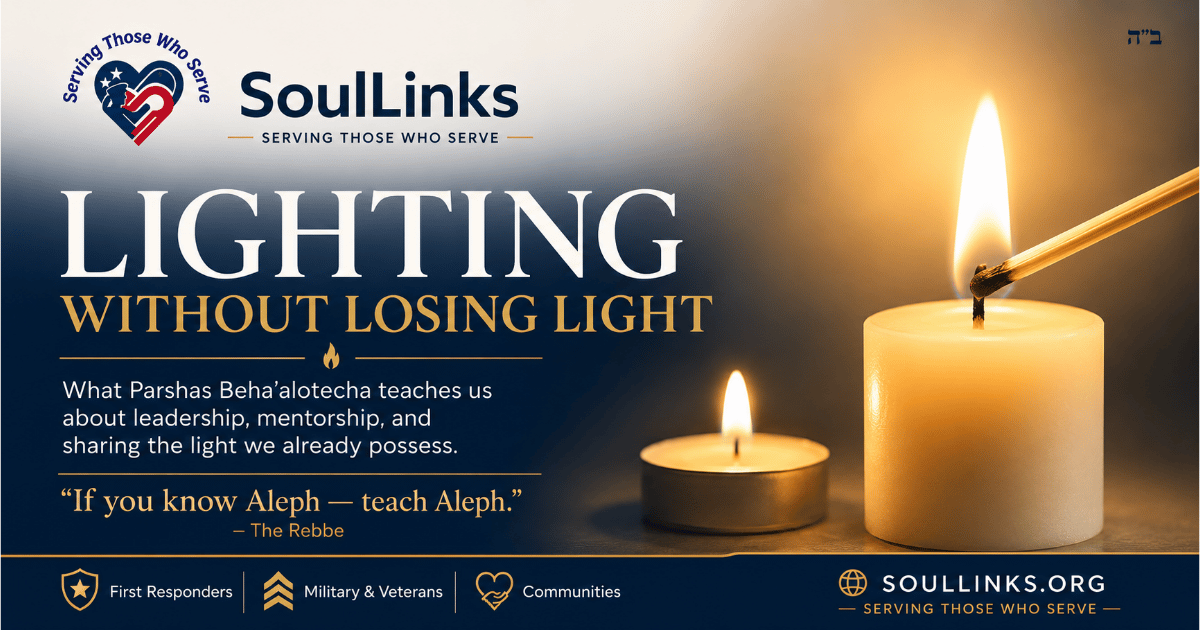
Lighting Without Losing Light
What Parshas Beha’alotecha teaches us about leadership, mentorship, and sharing the light we already possess.
Thank you for subscribing
Thank you for subscribing
Thank you for subscribing


We live in a world that quietly convinces people that they are unqualified to help.
“I’m not experienced enough.”
“I don’t know enough.”
“I’m still figuring things out myself.”
“Someone more knowledgeable should be the one to teach.”
It sounds humble. Sometimes it even sounds responsible.
But this week’s Torah portion, Parshas Beha’alotecha, offers a surprisingly different perspective.
The Torah opens with G-d’s instruction to Aaron regarding the Menorah:
דַּבֵּר אֶל־אַהֲרֹן וְאָמַרְתָּ אֵלָיו בְּהַעֲלֹתְךָ אֶת־הַנֵּרֹת אֶל־מוּל פְּנֵי הַמְּנוֹרָה יָאִירוּ שִׁבְעַת הַנֵּרוֹת
“Speak to Aaron and say to him: When you kindle the lamps, toward the face of the Menorah shall the seven lamps cast their light.”
(Bamidbar / Numbers 8:2)
At first glance, the instruction seems straightforward: light the Menorah.
Yet Rashi points out something remarkable in the Torah’s wording. The Torah does not simply say “when you light.” It says “בְּהַעֲלֹתְךָ - when you raise up the lamps” (literal translation).
Rashi explains that Aaron was instructed to hold the flame to each wick until the flame could rise on its own.
Aaron’s task was not merely to ignite.
His task was to kindle in a way that created a self-sustaining flame.
That subtle distinction holds a profound lesson not only for spiritual life but also for leadership, parenting, mentorship, friendship, chaplaincy, service, and everyday human connection.
One of the beautiful truths about a candle is that it behaves unlike almost anything else we possess.
If you give away money, you have less money.
If you give away time, you have less time.
But if one candle lights another, the original flame does not become weaker.
Its light is not diminished.
Instead, there is simply more light in the room.
The Lubavitcher Rebbe frequently emphasized this idea in different ways: sharing wisdom, encouragement, faith, kindness, or practical guidance does not impoverish the giver; it multiplies illumination.
Yet many people hesitate to share what they know.
They wait until they are experts.
They wait until they feel spiritually complete.
They wait until they know “enough.”
The Rebbe taught a powerful and practical principle:
If you know Aleph, teach Aleph.
You do not need to be an expert before becoming helpful.
If you know one letter, share one letter.
If you possess one lesson learned through hardship, share that lesson.
If you know how to listen without judgment, offer that gift.
If you know one healthy coping tool, one prayer, one skill, one insight, one act of compassion, do not underestimate its value.
Do not wait until you know everything before helping someone else grow. Someone else may be waiting for the exact piece of light you already possess.
There is another hidden barrier that prevents people from helping others: perfectionism.
Many people quietly assume:
“When I am stronger, then I’ll mentor.”
“When I’ve completely figured out my life, then I’ll guide someone else.”
“When I know much more, then I’ll teach.”
But human growth rarely works that way.
Often, the people who help us most are not flawless experts standing on distant mountaintops.
They are ordinary people, a few steps ahead of us.
A colleague who says, “I’ve been through something similar.”
A friend who makes a difficult phone call.
A parent who shares a lesson learned the hard way.
A veteran mentoring a younger service member.
An officer checking in on another officer.
A neighbor who notices someone struggling.
A chaplain who sits quietly beside someone carrying pain.
The world is often changed not by grand speeches, but by small flames passed quietly from one person to another.
Rashi’s teaching contains another profound insight.
Aaron was not instructed merely to create dependence.
He was told to kindle until the flame could rise on its own.
True leadership is not controlling others.
True mentorship is not making people permanently dependent upon us.
The highest form of helping is empowering another person to discover their own strength, resilience, dignity, and purpose.
Parents understand this.
Teachers understand this.
Good leaders understand this.
The goal is not simply to carry someone.
Sometimes, it is helping them remember they can walk.
Perhaps someone once believed in you when you doubted yourself.
Perhaps someone taught you something simple but life-changing.
Perhaps someone checked on you, listened to you, encouraged you, or quietly helped you through a difficult season.
That was light being shared.
Now the Torah asks a gentle but challenging question:
Who will you kindle?
Not after you become perfect.
Not after you know everything.
Now.
Who in your family, workplace, community, congregation, agency, or circle of friends could benefit from the light you already carry?
Because the truth is this:
You probably know more than you think you do.
You probably have more to give than you realize.
And the beautiful paradox of light is that when shared properly, it does not leave us depleted.
It leaves the world brighter.
At SoulLinks, we witness this principle regularly through chaplaincy, mentorship, spiritual care, and human connection among those who serve, law enforcement personnel, military members, veterans, first responders, and the communities around them.
Often, transformation does not begin with a dramatic moment.
It begins with one conversation.
One lesson.
One act of kindness.
One person willing to share the light they already possess.
This week, do not wait until you know everything.
If you know Aleph, teach Aleph.
Make the phone call.
Check on the colleague.
Encourage the struggling friend.
Teach the lesson you learned the hard way.
Share the wisdom, faith, resilience, or compassion that life has already placed in your hands.
Someone else’s flame may be waiting for yours.
Consistent acts of generosity do more than help others; they help shape who we become.
By joining the SoulLinks Chai Club, you help provide ongoing support, encouragement, and care for those who serve our communities, while also cultivating a life of compassion, purpose, blessing, and spiritual growth.
Small, consistent acts create lasting impact for others and for ourselves.