Living with Purpose in the Public Eye
What it means to carry responsibility, represent something greater, and bring dignity into every interaction
Thank you for subscribing
Thank you for subscribing
Thank you for subscribing
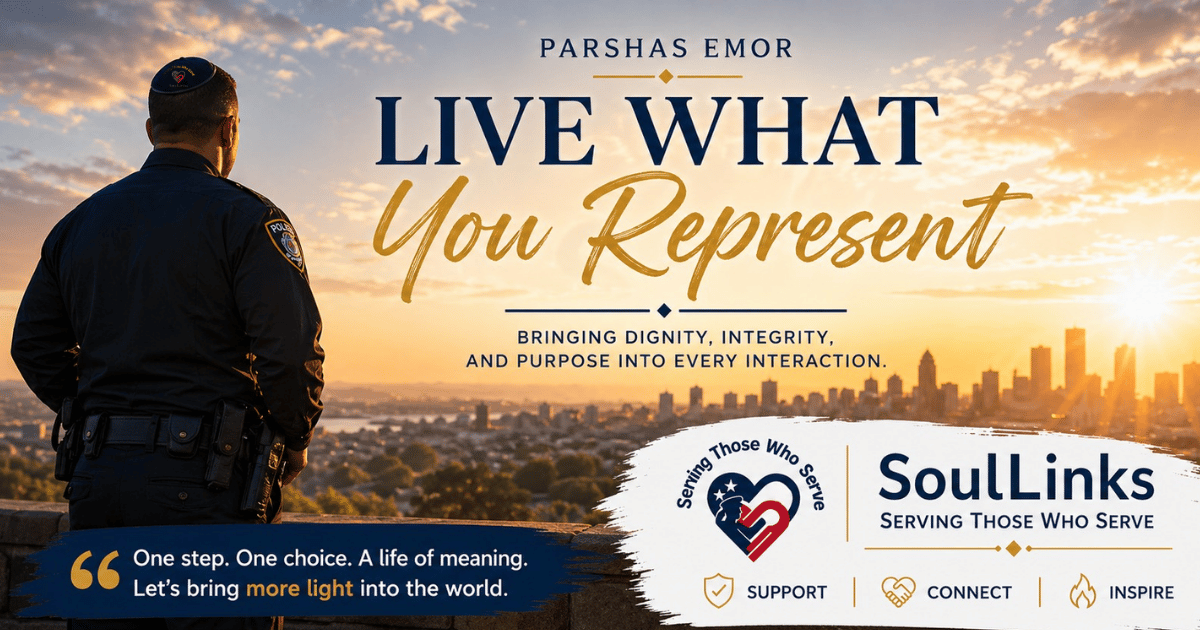

There’s a quiet yet powerful truth about leadership that often goes unspoken:
People aren’t just watching what we do; they’re learning how to live by how we do it.
This week, in Parshas Emor, the Torah introduces a powerful and demanding idea,
that there are those called to live with heightened awareness because of what they represent.
The Torah states:
“וְלֹא יְחַלְּלוּ שֵׁם אֱלֹקֵיהֶם…”
“They shall not profane the Name of their G-d…”
Vayikra (Leviticus) 21:6
And later:
“וְלֹא תְחַלְּלוּ אֶת־שֵׁם קָדְשִׁי, וְנִקְדַּשְׁתִּי בְּתוֹךְ בְּנֵי יִשְׂרָאֵל…”
“You shall not desecrate My holy Name, and I shall be sanctified among the Children of Israel…”
Vayikra (Leviticus) 22:32
While these verses are introduced in the context of the Kohanim, the message extends far beyond them.
This is a calling for every one of us.
The Rambam teaches that Kiddush Hashem, sanctifying G-d’s Name, is fulfilled through how a person lives their daily life.
Not just in dramatic moments,
But in ordinary interactions.
Because whether we realize it or not:
We are always representing something greater than ourselves.
Our values
Our community
Our mission
The Kohanim were held to a higher standard, not as a burden, but because of what they embodied.
They represented holiness in the world.
And in a deeper sense, so do we.
Especially those in public service, law enforcement, military, and emergency response, where every action reflects something larger than the individual.
But even beyond titles,
This responsibility belongs to all of us.
Chassidus adds a powerful dimension to this idea.
It’s not enough to avoid Chillul Hashem, to simply not desecrate G-d’s Name.
We are called to actively create Kiddush Hashem, to bring G-dliness into the world in a visible way.
The Lubavitcher Rebbe taught that “וְנִקְדַּשְׁתִּי” - “I shall be sanctified”, is not passive.
It is a mission.
And it happens not only in extraordinary circumstances,
But in everyday life:
Speaking calmly when others react
Acting with integrity even when unnoticed
Treating every person with dignity
In Chassidic thought, this is called making a “Dirah B’tachtonim”, a dwelling place for the Divine in the lowest, most ordinary parts of the world.
Which means:
Holiness is not found by stepping away from life; it is created by how we engage with it.
The Gemara (Yoma 86a) teaches:
When a person behaves with honesty and kindness, people say:
“Fortunate is the one who learned Torah… see how proper his ways are.”
That is Kiddush Hashem.
Not loud.
Not dramatic.
But deeply powerful.
When someone carries themselves with dignity, integrity, and calm under pressure,
People don’t just see the individual.
They see what that person represents.
And that creates a ripple effect.
This is especially true in the environments we serve at SoulLinks,
where moments of stress, uncertainty, and responsibility define daily life.
And yet,
It is precisely there that light can be brought in.
As you move through your week, consider this:
What do I represent, and how can I reflect it more clearly?
Not perfectly.
Just intentionally.
Because the most powerful leadership
is not what we say,
It’s what we live.
At SoulLinks, this is our mission:
To support, uplift, and strengthen those who serve, physically, emotionally, and spiritually.