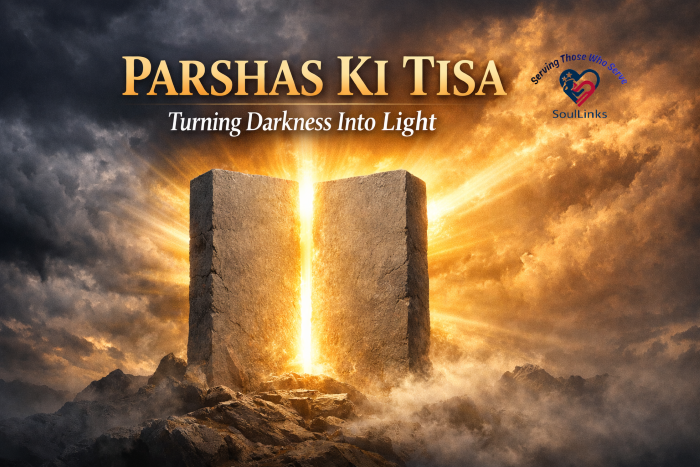
Turning Darkness Into Light
What Parshas Ki Tisa, the story of Purim, and today’s uncertain world teach us about leadership, resilience, and finding hope after failure.
Thank you for subscribing
Thank you for subscribing
Thank you for subscribing


There are times in history when everything appears to shake simultaneously.
Fear spreads.
Uncertainty rises.
And people begin asking the same question humanity has asked for thousands of years:
Where do we find strength when the world feels unstable?
This week’s Torah portion, Parshas Ki Tisa (Exodus 30:11–34:35), answers that question with a story that feels especially relevant today.
Because Ki Tisa contains one of the greatest crises in Jewish history.
And one of the greatest recoveries.
The Jewish people had just experienced the greatest revelation in human history.
Mount Sinai.
The Ten Commandments.
A direct encounter with the Divine.
And yet, just weeks later, everything collapsed.
When Moshe delayed returning from the mountain, panic spread across the camp. Fear replaced faith. The people demanded something tangible to lead them.
And the result was the Golden Calf.
It was a moment of spiritual collapse, a painful reminder that even a nation that had witnessed miracles could still fall into confusion and uncertainty.
Sound familiar?
Human beings, even at their strongest, can lose their sense of direction when fear takes over.
What happens next is the core of the Torah portion.
Moshe returns and observes what has occurred. The tablets are shattered. The nation stands at the edge of destruction.
But instead of abandoning the people, Moshe does something extraordinary.
He stands between the people and catastrophe.
He pleads.
He argues.
He refuses to give up on them.
In one of the most powerful statements in the Torah, Moshe tells G-d:
“If You will forgive them… but if not, erase me from the book You have written.”
(Exodus 32:32)
Moshe’s leadership was not defined by perfection.
It was defined by responsibility for others, even when they had failed.
True leadership involves supporting people, especially during their struggles.
The story doesn't conclude with failure.
It concludes with renewal.
Moshe ascends the mountain again.
New tablets are carved.
The covenant is restored.
And when Moshe descends the mountain once more, the Torah tells us something remarkable:
“The skin of Moshe’s face shone.”
(Exodus 34:29)
From the very place of brokenness, a new light emerged.
Sometimes the deepest spiritual growth comes not from perfection, but from recovery.
This week, we also celebrate Purim, a holiday born from another moment of crisis.
The Jewish people in Persia faced the threat of annihilation. A decree had been signed. The danger was real.
But the story of Purim reveals a profound truth.
What looked like darkness was actually the unfolding of hidden Divine guidance.
Every event, the sleepless king, Esther’s courage, and Mordechai’s leadership, formed part of a story that only became clear in hindsight.
Purim teaches us that even when G-d’s presence seems hidden, history is still moving toward redemption.
Unlike many other stories in the Torah, the Book of Esther never mentions G-d’s name even once. At first glance, the events of the story appear to be nothing more than politics, palace intrigue, and coincidence.
A king cannot sleep one night.
A forgotten record in the royal archives is discovered.
A young Jewish woman becomes queen at just the right moment.
A decree of destruction is suddenly reversed.
Each event on its own might seem ordinary. But when viewed together, a remarkable pattern emerges.
What appeared random turns out to be part of a carefully unfolding story.
This is one of the central ideas of Purim: sometimes Divine guidance is not obvious or dramatic. Sometimes it works quietly, behind the scenes, through the events of everyday life.
In Hebrew, this is called “hester panim” - the hiddenness of G-d’s presence.
The miracle of Purim was not a splitting of the sea or fire from heaven.
It was something more subtle: a chain of events that ultimately protected the Jewish people.
And the message is timeless.
Even when we cannot clearly see the direction of history…
Even when events seem confusing or frightening…
Even when faith is tested…
The story of Purim reminds us that the world is not random.
There is a deeper story unfolding, one that ultimately moves toward redemption, hope, and light.
Today, our brothers and sisters in Israel once again face difficult and uncertain days.
Tensions with Iran and ongoing security challenges remind us that the Jewish people still live in a complex and often dangerous world.
But Jewish history has taught us something remarkable:
We have faced moments of uncertainty before.
And again and again, we have discovered a strength deeper than fear.
A strength rooted in faith.
In community.
In purpose.
Just as in Ki Tisa and Purim, moments of challenge can become moments of renewal.
Immediately after the crisis of the Golden Calf, the Torah moves to a new mission:
Building the Mishkan - the Sanctuary.
Instead of remaining stuck in the past, the Jewish people were asked to build something sacred for the future.
That may be the most profound lesson of this week.
When the world feels uncertain, the answer is not despair.
The answer is to build.
Build connection.
Build kindness.
Build faith.
Build communities that bring light into the world.
Because even when history feels turbulent, the Jewish people have always known how to do one thing remarkably well:
Turn darkness into light.
And that light continues to guide us forward.