There is something fascinating about the names of this week’s two Torah portions.
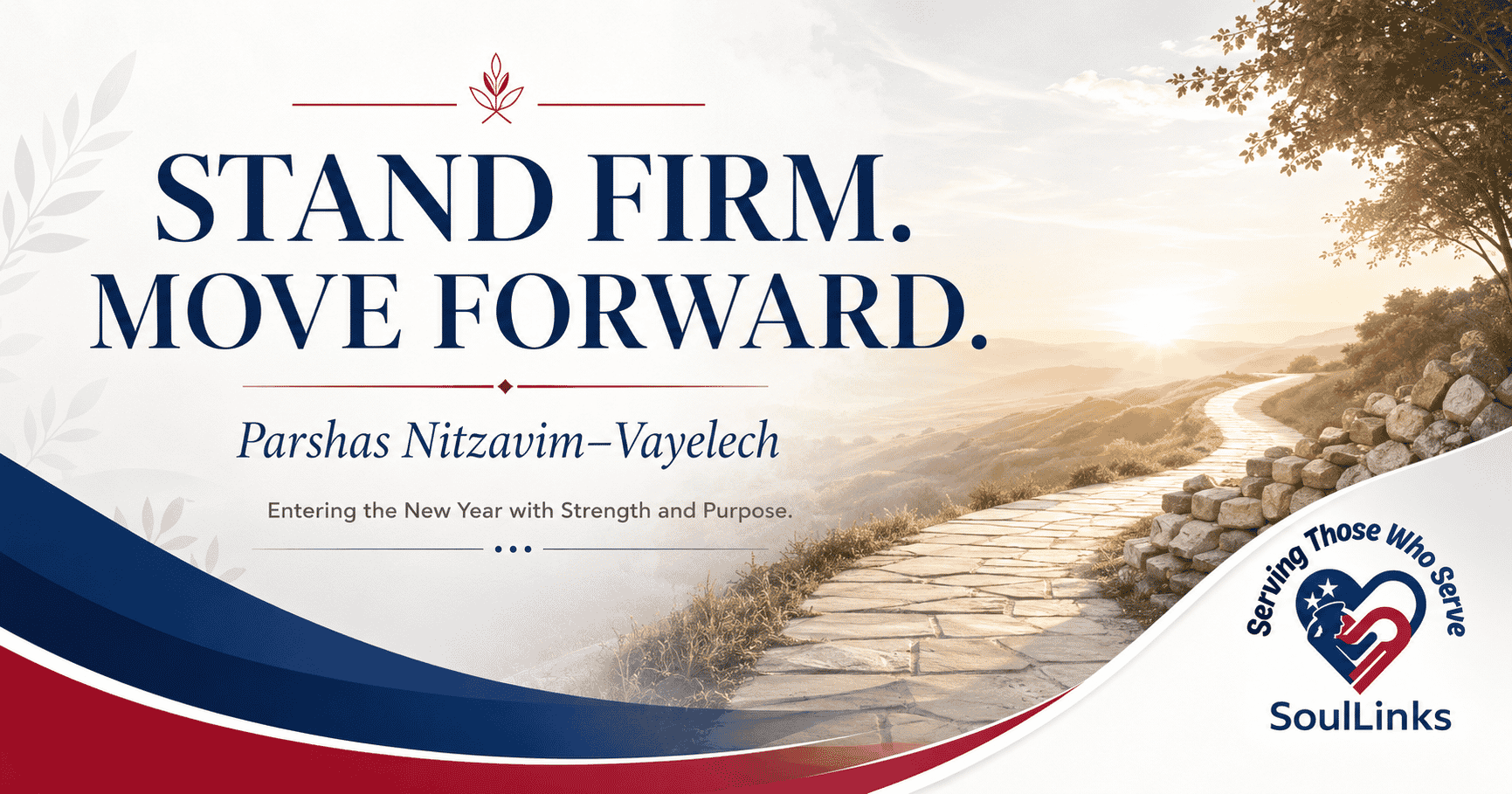
Nitzavim means standing firmly.
Vayelech means moving forward, literally, “and he went.”
At first glance, they seem to contradict one another.
Are we supposed to stand still or move?
Perhaps that question is exactly the point.
Before We Move, We Need to Know Where We Stand
Nitzavim opens with Moshe speaking to the entire Jewish people:
“Atem nitzavim hayom kulchem lifnei Hashem Elokeichem” - “You are standing today, all of you, before the Lord your G-d.”
(Deuteronomy 29:9)
Not some of you.
Not only the scholars, leaders, or spiritually accomplished.
All of you.
The Torah deliberately lists everyone, from leaders and elders to children, families, converts, woodcutters, and water drawers.
Before the Jewish people can enter the next chapter of their history, they first have to stand together and recognize where they are.
There is a powerful lesson here as we approach Rosh Hashanah (the Jewish New Year).
We spend much of Elul thinking about change.
What should I improve?
What should I stop doing?
What kind of person do I want to become?
Those are important questions. But perhaps before asking where we are going, we need to ask something more basic:
Where am I standing?
What are the values I refuse to surrender?
What relationships matter enough to protect?
What responsibilities have been entrusted to me?
What parts of myself do I want to carry into the coming year?
Growth does not always begin with movement.
Sometimes it begins with becoming firmly rooted.
But Standing Firm Is Not Standing Still
Then immediately comes Vayelech.
“Vayelech Moshe” - “And Moshe went.”
The Lubavitcher Rebbe points out the striking contrast between these two names.
Nitzavim represents firmness, stability, and conviction.
Vayelech represents movement, development, and continued growth.
And we need both.
A person without principles may move constantly but have no direction.
A person who refuses to move at all may have strong principles but never grow.
The goal is not rigidity.
And the goal is not change for the sake of change.
The goal is to become so grounded in what truly matters that those values give us the confidence to move forward.
Think of a tree.
The stronger its roots, the further its branches can extend.
Our lives work much the same way.
The New Year Does Not Require a New You
As Rosh Hashanah approaches, there can be enormous pressure to reinvent ourselves.
We make resolutions.
We think about everything we should have done differently.
We remember opportunities we missed, conversations we mishandled, people we neglected, goals we abandoned, and promises to ourselves that quietly disappeared somewhere during the year.
The list can become overwhelming.
But the Torah offers something much more hopeful.
Shortly after speaking about returning to G-d, Moshe tells us:
“For this mitzvah which I command you today is not beyond you, nor is it distant… It is not in heaven… nor is it across the sea… Rather, the matter is very close to you, in your mouth and in your heart, to do it.”
(Deuteronomy 30:11–14)
Change does not live somewhere far away.
It isn't reserved for a future version of ourselves who has more time, more discipline, fewer problems, or better circumstances.
It is close.
It begins here.
It begins now.
And often, it begins much smaller than we imagine.
One phone call we have been postponing.
One apology.
One commitment to be more present at home.
One extra moment of prayer.
One act of kindness nobody knows about.
One decision to listen instead of react.
One boundary that protects what matters.
One person we decide not to give up on.
One step.
“Choose Life”
Near the conclusion of Nitzavim, the Torah gives us one of its most powerful instructions:
“Uvacharta bachaim” - “Choose life.”
(Deuteronomy 30:19)
Life is made of choices.
Most of them do not announce themselves as life-changing decisions.
They arrive quietly.
How we respond when someone disappoints us.
Whether we make the call.
Whether we show up.
Whether we forgive.
Whether we try again after failing.
Whether we give someone our attention when it would be easier to look at our phone.
Whether we allow yesterday's mistake to become tomorrow's identity.
These small decisions eventually become a direction.
And direction becomes a life.
The Torah doesn't merely tell us that choices have consequences. It lovingly urges us:
Choose life.
Choose the path that creates more meaning.
More connection.
More goodness.
More purpose.
More G-dliness.
More life.
Courage Does Not Mean Having No Fear
Vayelech adds another message.
Moshe tells the Jewish people:
“Chizku v'imtzu” - “Be strong and courageous.”
(Deuteronomy 31:6)
They were facing enormous uncertainty.
Moshe, the leader who had guided them for forty years, was preparing to leave them. They were about to cross into unfamiliar territory under new leadership.
Moshe did not promise them there would be nothing frightening ahead.
He told them not to allow fear to determine their direction.
That may be one of the most important messages to carry into a new year.
We do not know what 5787 will bring.
None of us does.
There will be blessings we cannot yet imagine and challenges we would never choose.
Courage is not predicting the future.
It is entering the future knowing what we stand for.
Stand. Then Walk.
Perhaps that is why these two portions belong together just before Rosh Hashanah.
Nitzavim.
Stand firm.
Remember who you are.
Remember what matters.
Remember the people who depend on you.
Remember the values you want your life to represent.
And then,
Vayelech.
Go.
Do not remain frozen in reflection.
Take what you discovered and turn it into movement.
Make the call.
Start the conversation.
Give the charity.
Repair the relationship.
Begin the project.
Return to the practice you allowed to slip.
Take one concrete step toward becoming the person you already know you can be.
We don't need to enter the new year perfect.
We need to enter it standing firmly and willing to walk forward.
Because sometimes the most important journey of a new year begins not with a dramatic transformation,
but with knowing where you stand,
and choosing your next step.
Shanah Tovah U’Metukah. May we all be blessed with a sweet new year filled with health, strength, purpose, connection, and the courage to keep moving forward.
"Serving Those Who Serve" - and strengthening the links that connect us all.
As we enter the month of Elul, a time of reflection, renewal, and increased tzedakah, consider adding one more lasting mitzvah to your year.
By joining the SoulLinks Chai Club, your monthly support helps provide encouragement, spiritual care, and critical resources to first responders, law enforcement, military personnel, veterans, and their families.
Small acts of generosity, repeated consistently, can create lasting impact.
Join the Chai Club today and help ensure that those who serve others know they are never alone.