The Ark Is Not the Destination
When life feels overwhelming, Parshas Noach teaches us not only where to find strength, but also what to do with it afterward.
Thank you for subscribing
Thank you for subscribing
Thank you for subscribing
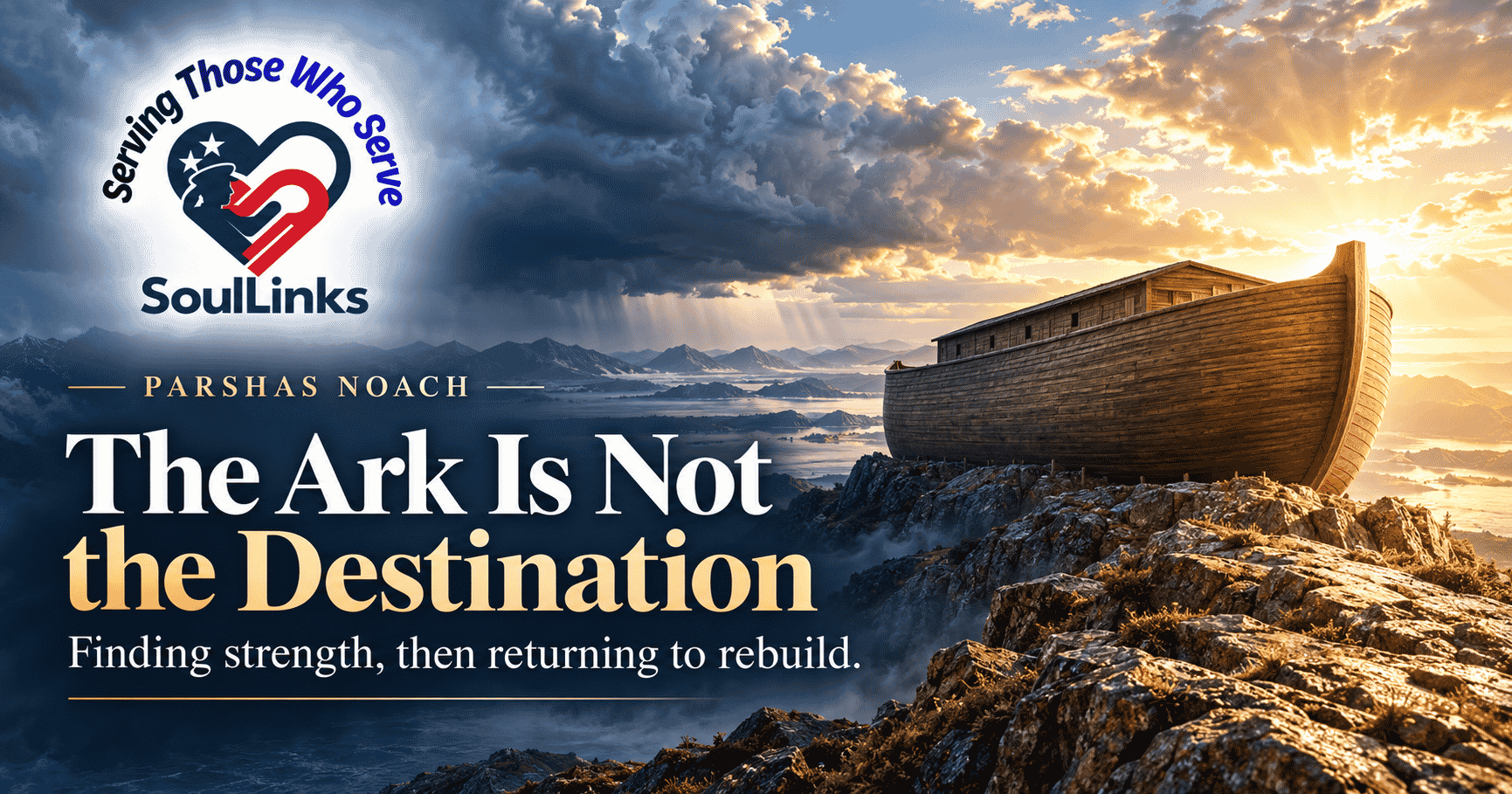


There are moments when life feels like a flood. Not necessarily because one terrible thing has happened, but because everything seems to be happening at once. The phone calls, the responsibilities, the decisions, the expectations, the people depending on us, the problems we can solve, and the ones we cannot.
For those whose lives revolve around serving others, that feeling can be especially familiar. First responders run toward emergencies. Law enforcement officers walk into situations others are trying to escape. Military personnel carry responsibilities most people will never see. Chaplains, caregivers, parents, and community leaders often become the people others turn to when life begins to fall apart.
But we rarely ask this question: Where does the person carrying everyone else go when the waters begin rising around them?
Parshas Noach offers an answer that is far more relevant than we might first imagine.
When the Flood begins, Noach is told, “Come into the ark.”
On a deeper level, the Hebrew word Teivah, which means “ark,” can also mean a “word.” This teaches us that when the waters of life begin to overwhelm us, we are meant to enter deeply into the words of Torah and prayer, letting those words surround us, steady us, and remind us that something greater and more enduring than the turmoil around us exists.
This is more than simply taking a break from the noise. It is about reconnecting to something that gives the noise perspective.
Prayer creates a space in which we remember that we are not carrying the world alone. Torah reminds us that our lives have direction, values, and purpose even when the circumstances around us feel chaotic. These words become an ark: not because they make every difficulty disappear, but because they give us a place to stand while the waters are rising.
And that idea carries a broader lesson as well. Everyone needs moments when the urgency quiets enough to reconnect with what anchors them. A conversation with someone we trust, time with family, or a few minutes of honest reflection can help us regain perspective, but the teivah's deeper teaching is that our strongest refuge comes from entering the words that reconnect us with G-d, meaning, and purpose.
We cannot always stop the flood.
But we can build something inside ourselves that the flood cannot wash away.
There is no weakness in needing that space. Even Noach needed an ark.
Then comes the part of the story we often overlook.
Eventually, the waters recede, and Noach is told, “Go out from the ark.”
The very place that protected him was never meant to be where he remained forever. That distinction may hold one of the story's most important lessons.
There is a difference between finding refuge and hiding from life.
We step away so that we can return. We pray so that we can serve. We regain perspective so that we can make better decisions. We allow ourselves to breathe so we can be fully present again for the people who depend on us.
Our ark is not an escape from the world. It is the place where we gather the strength to go back into it.
Another remarkable detail in the story stands out. Noach did not spend his time inside the ark simply resting and waiting for the storm to pass. For months, he fed and cared for every living creature aboard. Each animal had different needs, different schedules, and different demands.
Even inside the place that protected Noach, his life still centered on responsibility and care.
That carries a powerful lesson. There will absolutely be moments when we need to stop, recover, grieve, reflect, or restore ourselves. But the goal of becoming stronger is not simply to become more comfortable. It is to become more capable of helping someone else.
Who needs encouragement? Who needs someone to listen? Whose burden can we lighten a little? Who is standing in a flood of their own and needs someone steady beside them?
Those questions turn resilience into something larger than self-preservation.
They turn it into service.
One of the most exhausting beliefs we can carry is that peace will finally come once everything is resolved. Once the difficult conversation is over. Once the investigation is finished. Once the deployment ends. Once the family issue settles. Once the finances stabilize. Once the diagnosis changes. Once everyone we care about is finally okay.
But life rarely gives us that kind of complete resolution.
There will almost always be another wave.
Perhaps peace is not the absence of waves. Perhaps peace is knowing what keeps us anchored when they come.
The Flood itself lifted the ark higher. That image is deeply meaningful. Sometimes the very experiences that threaten to overwhelm us force us to discover strength, patience, humility, compassion, or faith that might otherwise have remained hidden.
That does not mean suffering is easy, and it certainly does not mean pain should be minimized. But it does mean that the storm does not have to get the final word.
Sometimes the waters that threaten to pull us under can also carry us somewhere higher.
Perhaps that is the challenge Parshas Noach leaves us with.
When the world feels overwhelming, build your ark. Enter the words of prayer and Torah. Reconnect with the truths that remind you who you are, why you are here, and what is ultimately worth holding onto.
Allow those moments to steady you.
Allow them to restore perspective.
And when you regain your footing, open the door.
Walk back into the world and bring something with you: more patience, more courage, more compassion, more faith, more willingness to notice the person everyone else overlooked.
Because the purpose of finding peace is not merely to become peaceful.
It is to become capable of bringing peace into someone else’s storm.
Noach survived the Flood, but survival was not the end of his mission. There was still a world outside the ark waiting to be rebuilt.
And there still is.
One person, one relationship, one courageous decision, one act of kindness, and one moment of service at a time.
Every day, first responders, law enforcement officers, military personnel, veterans, and their families dedicate themselves to serving and protecting others. SoulLinks helps serve those who serve.
By joining the SoulLinks Chai Club, your monthly support helps provide encouragement, spiritual care, meaningful connections, and critical resources to those who dedicate their lives to others.
A small act of generosity, repeated consistently, can create a lasting impact.
Tzedakah teaches us that giving is more than a single act; it is a commitment to bringing goodness into the lives of others. Through the SoulLinks Chai Club, that commitment becomes an ongoing source of support for the people and families who are so often there for us when we need them most.
Join the SoulLinks Chai Club today and help ensure that those who devote themselves to serving and protecting others know that they are supported, appreciated, and never alone.

"Serving Those Who Serve" - and strengthening the links that connect us all.