The Courage to See
Real compassion begins when we look beyond what is visible and recognize the person, the struggle, and the choice standing before us.
Thank you for subscribing
Thank you for subscribing
Thank you for subscribing
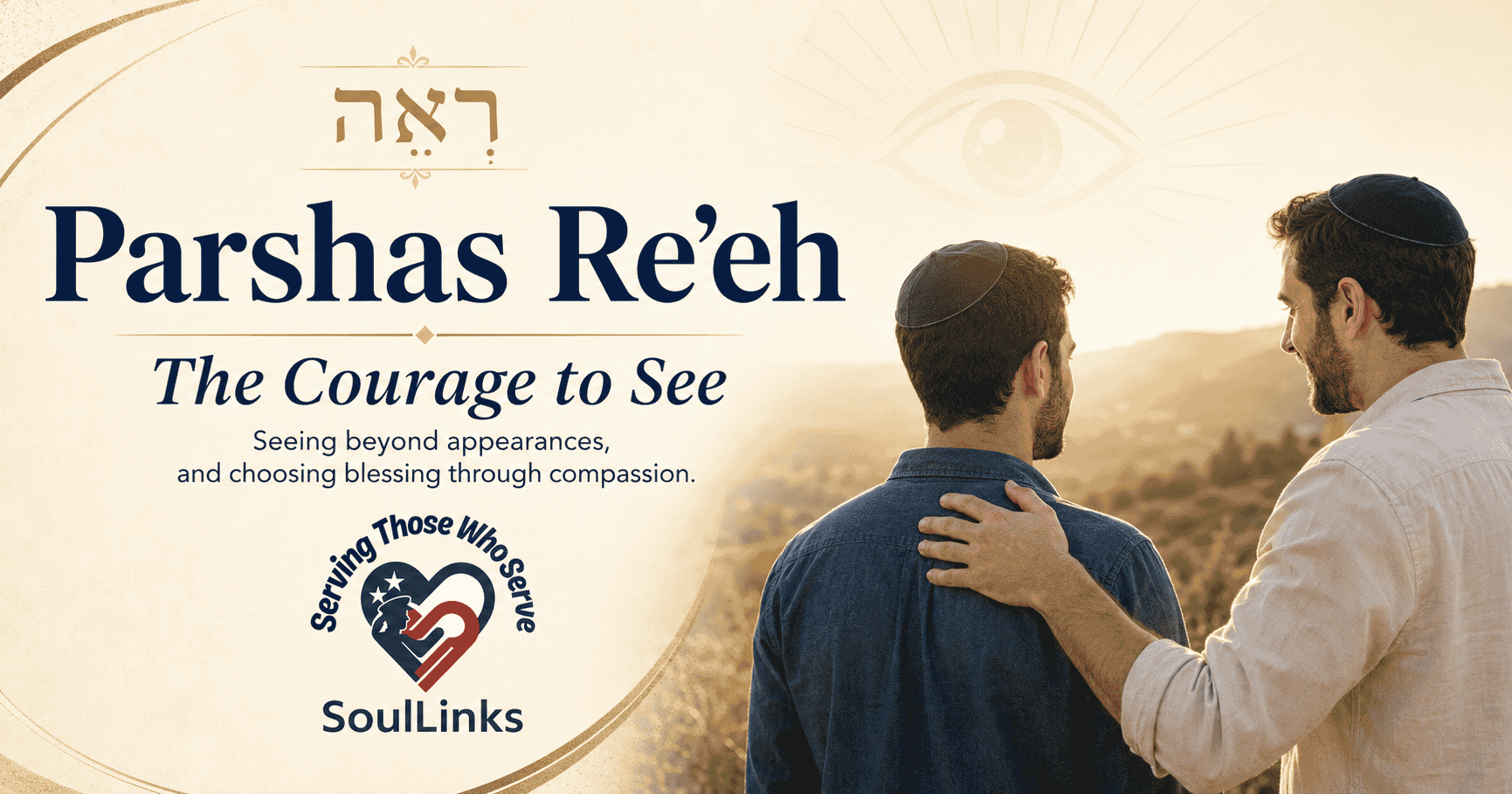


“See, I set before you today a blessing and a curse.”
Deuteronomy 11:26
Parshas Re’eh opens with a single, powerful word:
רְאֵה - Re’eh - See.
Moshe (Moses) does not merely ask the Jewish people to listen, understand, or believe. He asks them to see.
Before speaking about the blessing and the curse, the right path and the wrong one, Moshe teaches us that meaningful choices begin with the way we look at the world.
Because two people can encounter the same situation and see entirely different things.
One sees an inconvenience.
Another sees a person who needs patience.
One sees a difficult personality.
Another sees someone carrying pain that has never been expressed.
One sees a mistake.
Another sees an opportunity to guide, encourage, and rebuild.
One sees a closed door.
Another sees an invitation to search for a different way forward.
The circumstances may be identical. The difference lies in what each person chooses to see.
The Torah’s wording is striking:
רְאֵה אָנֹכִי נֹתֵן לִפְנֵיכֶם הַיּוֹם בְּרָכָה וּקְלָלָה
“See, I set before you today a blessing and a curse.”
The word “today” reminds us that the defining choices of life are not made only during dramatic moments. They are made today—in ordinary conversations, hurried interactions, private reactions, and decisions that may appear insignificant.
Every day places something before us.
Will we respond with anger or restraint?
Will we protect our pride or preserve a relationship?
Will we ignore someone’s struggle or pause long enough to notice?
Will we focus only on what went wrong, or will we search for what can still be repaired?
A blessing is not always something that simply arrives. Sometimes, it is a path placed before us, a path we must recognize and choose.
The opening verses of Re’eh describe blessing as connected to listening to G-d’s commandments and the opposite path as turning away from them. The Torah therefore presents life not as a random collection of events, but as a series of meaningful choices with direction and consequence.
Later in the parshah, the Torah turns to the responsibility of helping someone in need:
כִּי־יִהְיֶה בְךָ אֶבְיוֹן מֵאַחַד אַחֶיךָ בְּאַחַד שְׁעָרֶיךָ בְּאַרְצְךָ אֲשֶׁר־ה׳ אֱלֹקֶיךָ נֹתֵן לָךְ לֹא תְאַמֵּץ אֶת־לְבָבְךָ וְלֹא תִקְפֹּץ אֶת־יָדְךָ מֵאָחִיךָ הָאֶבְיוֹן׃
“If there will be among you a needy person, from one of your brothers in one of your cities, in your land that the L-rd your G-d is giving you, you shall not harden your heart, and you shall not close your hand from your needy brother.”
Deuteronomy 15:7
The sequence is important.
Before a hand closes, a heart closes.
And before a heart closes, we often stop truly seeing.
We may see someone’s uniform, title, position, or outward strength while missing the human being underneath it. We may assume that the person who is always helping others does not need help. We may mistake silence for stability, professionalism for invulnerability, or a smile for the absence of pain.
The Torah tells us not to look away.
“Open your hand” does not refer only to financial assistance. An open hand can offer time, encouragement, dignity, patience, advocacy, guidance, or simply the reassurance:
“You do not have to carry this alone.”
The Torah speaks of meeting the person’s actual need, not merely offering whatever is easiest for the giver. That requires more than generosity. It requires attention. We must first see the individual before us and understand what is missing for that person.
This lesson becomes especially important when someone disappoints us.
It is easy to see the behavior. It takes wisdom to look for what may be driving it.
This does not mean excusing wrongdoing, removing accountability, or pretending that harmful choices do not matter. Healthy compassion does not require blindness.
But accountability and humanity can exist together.
We can correct someone without humiliating them.
We can establish boundaries without abandoning them.
We can acknowledge a failure without deciding that the failure defines the entire person.
Sometimes the question is not merely, “What did this person do?”
The deeper question is:
“What am I failing to see?”
Perhaps the anger is covering fear.
Perhaps the withdrawal is hiding embarrassment.
Perhaps the resistance comes from feeling unheard.
Perhaps the person who appears indifferent has simply lost hope that anyone will understand.
We may not always know the full story. But remembering that there is a story can change the way we respond.
The best leaders are not always the loudest, most commanding, or most visible.
They are often the people who notice.
They notice the team member whose energy has changed.
They notice the officer who has become unusually quiet.
They notice the service member who keeps saying, “I’m fine,” but no longer seems like himself.
They notice the employee who is still performing but is slowly becoming overwhelmed.
They notice the family member who continues caring for everyone else while privately running out of strength.
Noticing does not always require a major intervention. Sometimes it begins with a private conversation:
“I may be mistaken, but you don’t seem like yourself lately. How are you really doing?”
That question may not solve the problem.
But it can open a door.
And sometimes an open door is the first blessing a person has seen in a very long time.
Re’eh means “see,” but seeing is more than observing what is directly in front of us.
It means choosing to look again.
To look beyond appearances.
To look beneath reactions.
To look for possibilities where others see only problems.
To look for the spark of dignity that remains even in someone who is struggling.
And to look honestly at ourselves: at the attitudes we carry, the assumptions we make, and the opportunities for kindness that we overlook.
The Torah says that blessing and its opposite are placed before us.
Often, the first difference between those paths is not what happens around us.
It is what happens within us.
It is the moment we decide whether to harden our hearts or open them, whether to close our hands or extend them, whether to look away or truly see.
This week, let us ask ourselves:
Who around me may need to be seen more deeply?
What situation have I judged without understanding fully?
Where is a blessing already before me that I have not yet recognized?
Because when we learn to see differently, we begin to respond differently.
And sometimes, the blessing begins the moment another person realizes:
“Someone finally sees me.”
The most meaningful impact is often created through small acts of generosity repeated consistently over time.
By joining the SoulLinks Chai Club, you help provide ongoing support, encouragement, spiritual care, and critical resources to first responders, law enforcement, military personnel, veterans, and their families.
Together, we can ensure that those who serve others know they are not alone.