There are moments in life when everything seems to become a little clearer.
Sometimes it happens in a synagogue on Yom Kippur. Sometimes it happens after a difficult call, a close encounter, a deployment, a conversation with someone we love, or an experience that suddenly reminds us how fragile and precious life really is.
For a moment, the noise fades.
We remember what matters.
We think about the kind of person we want to be, the relationships we may have taken for granted, and the values we want to live by.
The challenge is what happens afterward.
Because eventually the phone rings again. The radio goes off. The emails return. The next shift begins. The family needs us. The responsibilities waiting on our desk have not disappeared.
Life resumes.
And that raises an important question:
How do we take something we felt deeply and turn it into something we actually live?
That may be one of the most beautiful messages of Sukkot.
This year, Sukkot begins Friday evening, September 25. Because the first day of Sukkot falls on Shabbat, the regular weekly Torah reading gives way to the holiday's special Torah reading. Sukkot itself begins only five days after Yom Kippur, creating one of the most striking transitions on the Jewish calendar.
Yom Kippur asks us to stop.
Sukkot asks us to move forward.
What Happens After the Moment?
Yom Kippur removes us temporarily from ordinary life. We fast, pray, reflect, and try to reconnect with the deepest part of ourselves.
And then Judaism does something fascinating.
It does not allow us to remain there.
Just a few days later, we leave the synagogue and enter a sukkah.
The sukkah is a temporary structure covered with branches. For seven days, Jewish tradition asks us to treat it much like our home. We eat, spend time, study, and bring ordinary human activity into this sacred space.
The Lubavitcher Rebbe highlights what makes this mitzvah so unusual.
Many mitzvot involve a particular part of us. We may use our hands, our minds, our voices, or our hearts.
But when someone enters a sukkah, the entire person enters the mitzvah.
Not only while praying.
Not only while studying.
Even while sitting down for a meal or simply spending time with family and friends.
The Rebbe explains that the sukkah teaches us that our connection with G-d is not meant to be limited to traditionally “religious” moments. The holiness of life is meant to reach into its ordinary corners as well.
That lesson feels especially meaningful immediately after Yom Kippur.
It is one thing to feel inspired.
It is another thing entirely to carry that inspiration with us when life gets complicated.
Values Matter Most When Life Gets Busy
Anyone who serves others understands this.
A uniform can represent values such as courage, integrity, responsibility, discipline, compassion, and service. But those values matter most when they are tested.
They matter when a shift has already gone too long, and another call comes in.
They matter when circumstances are frustrating.
They matter when someone is frightened, angry, grieving, or difficult.
They matter when no supervisor is standing nearby, and no one will ever know what choice was made.
The same is true for all of us.
The values we speak about when life is calm become meaningful when we carry them into moments that are inconvenient, uncomfortable, or exhausting.
The patience we promised ourselves should show up when someone tests it.
The gratitude we felt should still be there when the routine returns.
The commitment to family should become another phone call, another conversation, another moment of genuine presence.
Faith should not disappear when uncertainty returns.
Compassion should survive a difficult day.
Integrity should still guide us when taking the easier route would be tempting.
Perhaps this is why Sukkot comes precisely when it does.
Yom Kippur helps us identify what matters.
Sukkot teaches us to build those values into the way we live.
A Different Kind of Security
The sukkah offers another powerful lesson.
For most of the year, we naturally look for stability. We build strong homes, make plans, create routines, save money, prepare for emergencies, and do everything responsible people are supposed to do.
Then Sukkot asks us to spend time in a structure that is intentionally temporary.
Its roof is made from natural growth. We can see the sky through it. We are more aware of the wind, the temperature, and the world beyond our walls.
Jewish tradition remembers through the sukkah the protection G-d gave the Jewish people during their journey through the desert after leaving Egypt.
That does not mean that planning and preparation do not matter.
They do.
But the sukkah quietly reminds us that even after we have done everything within our control, not everything is within our control.
People in public safety and military service may understand that reality particularly well.
Training matters.
Equipment matters.
Preparation matters.
But experience teaches us that life still contains variables no one can completely predict.
Sukkot asks us to live responsibly while also remembering that security is bigger than the walls we build around ourselves.
There is humility in that realization.
And there can also be comfort.
From Solemnity to Joy
Sukkot is also known as Zman Simchateinu - “the season of our rejoicing.”
That may seem surprising so soon after the seriousness of Yom Kippur.
But the two are deeply connected.
The High Holidays aren't meant to leave us feeling permanently weighed down. Reflection has a purpose. Accountability has a purpose. Teshuvah, returning and reconnecting, has a purpose.
They are meant to help us live differently.
And then comes joy.
Sukkot takes the spiritual work of the High Holidays and brings it into lived experience. It is not merely about thinking differently; it is about eating, gathering, celebrating, and living differently.
This offers an important lesson for anyone carrying responsibility.
Serious work does not require a joyless life.
Those who serve frequently see things others never see. They may encounter grief, danger, trauma, conflict, or simply the cumulative weight of being responsible for other people.
Perhaps that makes moments of joy even more important.
A meal with family.
A laugh with a colleague.
A conversation with a friend.
A moment of gratitude.
A chance to recognize that alongside everything difficult in the world, there is still goodness worth noticing and life worth celebrating.
Joy is not necessarily the absence of hardship.
Sometimes it is the decision not to allow hardship to take everything from us.
Different People, Standing Together
Sukkot carries one more lesson that speaks powerfully to communities built around service.
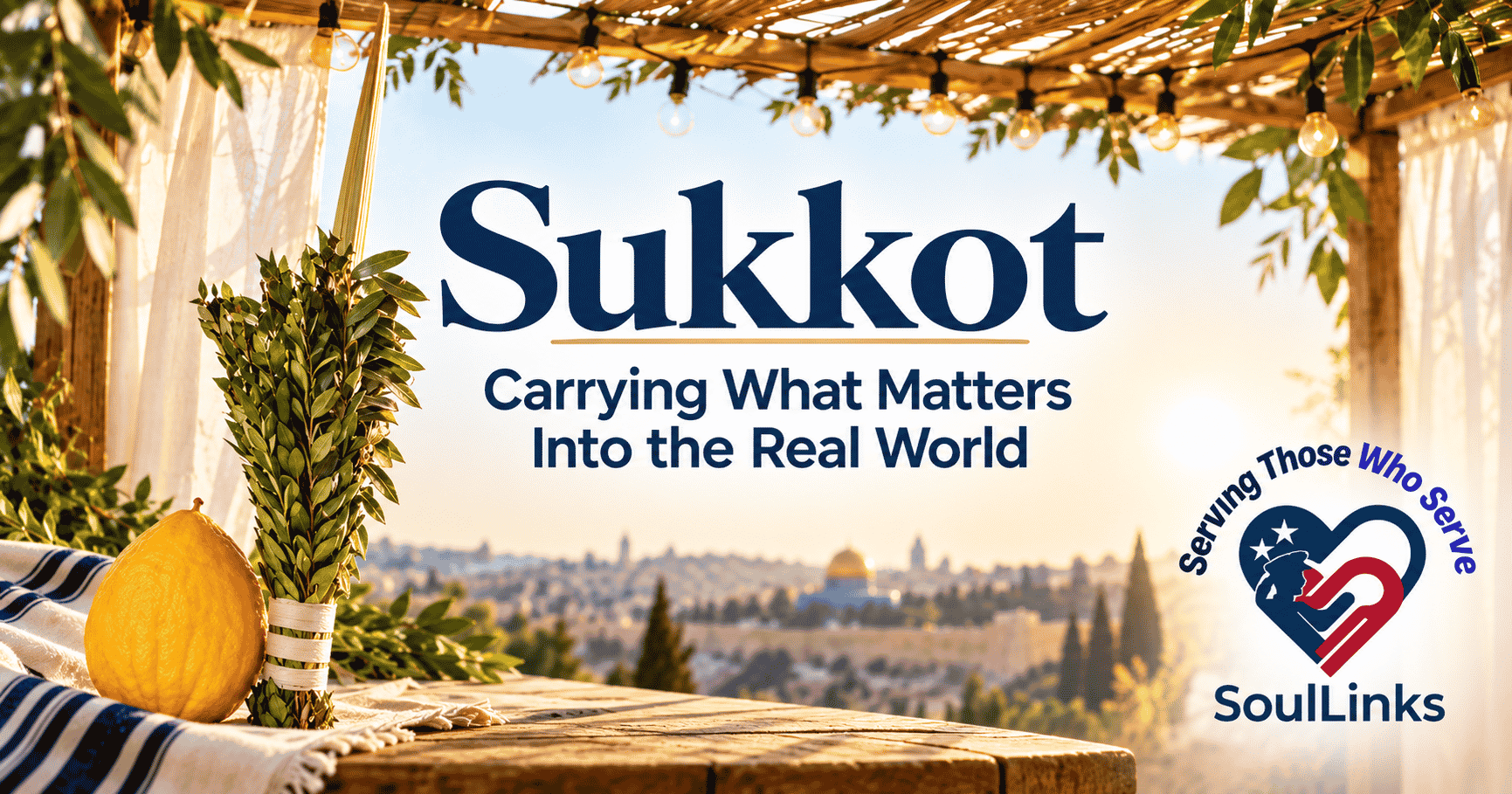
One of the holiday's central mitzvot is taking the Four Kinds: the lulav, etrog, myrtle, and willow.
They are completely different from one another, yet the mitzvah requires bringing them together.
Jewish teaching has long understood these four species as symbols of different kinds of people, each with different strengths, abilities, and qualities. The Lubavitcher Rebbe repeatedly used the Four Kinds to emphasize Jewish unity: difference does not have to disappear in order for unity to exist.
That lesson extends easily beyond the holiday.
A strong unit is rarely made up of identical people.
Neither is a strong family, organization, agency, congregation, or community.
People bring different personalities, backgrounds, experiences, talents, and perspectives.
Unity does not mean pretending those differences do not exist.
It means recognizing that sometimes our strength comes precisely from bringing those differences together around a shared purpose.
Taking It With Us
Perhaps that is the challenge Sukkot leaves us with.
Do not let the meaningful moment remain only a moment.
If something became clearer to us during the High Holidays, carry it forward.
If we realized that a relationship matters, invest in it.
If we recognized that someone deserves our appreciation, tell them.
If we decided we wanted to become more patient, compassionate, disciplined, grateful, or present, find one practical place to begin.
We do not have to transform everything overnight.
Often the biggest changes begin quietly.
One conversation handled differently.
One call returned.
One apology offered.
One act of kindness.
One difficult decision made with integrity.
One additional moment spent with the people who matter.
For those who wear a uniform, those who support them, those who serve communities in other ways, and those simply trying to navigate the responsibilities of everyday life, the lesson is the same:
What matters most should not remain something we think about only during extraordinary moments.
It should become part of the way we answer the next call, enter the next room, speak to the next person, and return home to the people waiting for us.
Yom Kippur gives us a chance to remember who we want to be.
Sukkot invites us to take that person back into the real world.
Chag Sameach.
As we move from the inspiration of the High Holidays into the year ahead, this is a meaningful time to turn good intentions into something lasting.
By joining the SoulLinks Chai Club, your monthly support helps provide encouragement, spiritual care, and critical resources to first responders, law enforcement, military personnel, veterans, and their families.
A small act of generosity, repeated consistently, can create a lasting impact.
Sukkot reminds us that meaningful values are meant to become part of everyday life. One simple way to carry that spirit forward is through the enduring mitzvah of Tzedakah.
Join the SoulLinks Chai Club today and help ensure that those who devote themselves to serving and protecting others know that they are supported, appreciated, and never alone.
"Serving Those Who Serve" - and strengthening the links that connect us all.