Thank you! Your submission has been received


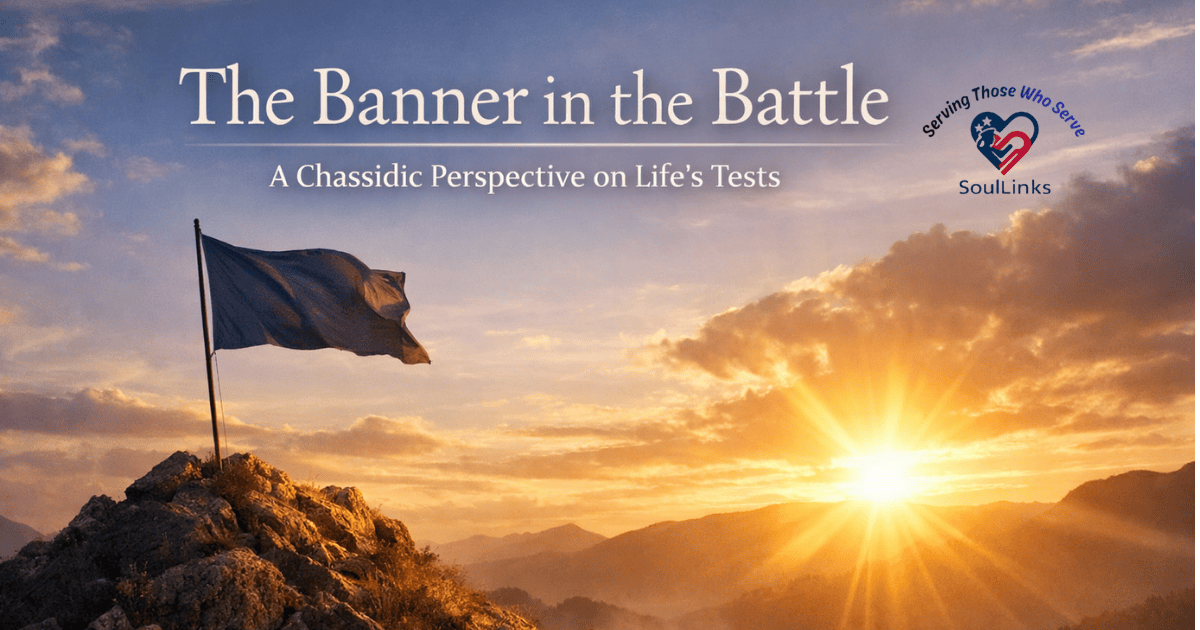
Life has a way of presenting us with moments that test our strength.
Sometimes the challenge is physical.
Sometimes emotional.
Sometimes spiritual.
There are moments when the road ahead feels uncertain, and the truth itself seems hidden behind layers of confusion or darkness.
King David captures this experience in a powerful verse in the Book of Psalms:
“You have given those who fear You a banner to raise, for the sake of truth.” נָתַתָּה לִּירֵאֶיךָ נֵּס לְהִתְנוֹסֵס מִפְּנֵי קֹשֶׁט סֶלָה
— Psalms 60:6
At first glance, the verse appears to speak about miracles. But in a profound Chassidic discourse, the Lubavitcher Rebbe, Rabbi Menachem Mendel Schneerson, reveals a deeper meaning hidden within the Hebrew words.
The key lies in the word “nes” (נס).
In Hebrew, the word carries two seemingly different meanings.
It can mean a miracle.
But it can also mean a banner raised high above the ground.
The Rebbe explains that these two meanings are deeply connected. When a person faces a spiritual test, what Judaism calls a nisayon, that challenge has the potential to lift them higher than they ever imagined.
The test itself becomes the banner.
Two Types of Spiritual Work
Chassidic teachings describe two primary ways that human beings elevate the world.
The first is known as “Avodat HaBirurim” - the work of refinement.
This idea, based on Kabbalah and Chassidic thought, teaches that sparks of holiness are hidden throughout the physical world. Daily experiences, food, work, relationships, and acts of kindness offer chances to uncover that hidden holiness.
When we use the physical world for meaningful purposes, we elevate it.
When we give charity, show compassion, act with integrity, or bring holiness into our daily lives, we reveal those hidden sparks.
This is the ordinary spiritual work of life.
But the Rebbe explains that another category exists entirely.
This is the category of tests.
When the Light Is Hidden
A test is different from an ordinary challenge.
In the work of refining the world, the holiness inside a situation is present and accessible. It may require effort to uncover, but it is there.
A test, however, feels very different.
In a test, the truth itself can feel concealed.
The situation may appear confusing, unfair, or even overwhelming. The path forward is not always clear, and the spiritual purpose of the moment may be difficult to see.
This is why tests are called nisyonot.
The word itself shares a root with “nes,” a banner raised high.
A test has the power to elevate a person, but only if they rise to meet it.
In these moments, the spiritual work is not necessarily about fixing the external situation.
Instead, it is about strengthening the inner core of the soul.
The Essence of the Soul
When a person faces a true test, intellect alone is not enough.
Logic may not provide answers.
Emotion may not provide stability.
Instead, a person must draw upon something deeper, the essence of the soul, the part of the human spirit that remains connected to G-d regardless of circumstances.
This connection is not dependent on understanding.
It is rooted in faith, purpose, and inner strength.
When a person stands firm in that connection, something remarkable happens.
The test begins to lose its power.
The darkness begins to lift.
And the person emerges from the experience stronger, clearer, and more elevated than before.
In this way, the challenge itself becomes the banner that raises a person higher.
The Tests of Our Generation
The Lubavitcher Rebbe often spoke about the unique spiritual challenges of our generation.
We live in a world of extraordinary progress and opportunity, yet also one filled with uncertainty, moral complexity, and rapid change.
At times, it can feel as though clarity itself is difficult to find.
Yet the Rebbe offered a powerful reassurance.
The very fact that a generation faces certain challenges means that it has been given the strength to overcome them.
Every soul is given the tools needed to rise to the tests placed before it.
In other words, the tests themselves are not signs of weakness.
They are signs of potential.
They reveal the greatness that lies within the human spirit.
Courage in the Face of Darkness
This message resonates deeply with those who dedicate their lives to serving others.
Law enforcement officers, first responders, military personnel, and community leaders regularly encounter situations that test their resilience, their judgment, and their faith in humanity.
They see the world not only at its best but often at its most difficult.
And yet, again and again, they choose to stand firm.
They choose to help.
They choose to protect.
They choose to serve.
These choices reflect something profound about the human soul.
Even when darkness appears overwhelming, a person's inner moral compass can stay steady.
That inner strength is what the Rebbe describes as the essence of the soul.
Raising the Banner
The verse in Psalms tells us that G-d gives those who fear Him a banner to raise for the sake of truth.
The Rebbe explains that this banner is not separate from the challenges themselves.
The banner is the challenge.
It is the moment in which a person’s courage, faith, and character become visible.
The challenges we face do not define who we are.
But how we respond to them does.
When we choose integrity over despair, faith over cynicism, and purpose over fear, we transform life’s tests into moments of elevation.
The banner rises.
And through those moments, both the individual and the world around them are lifted higher.
Sources
Psalms 60:6
Maamar “Nasata Liyerecha Nes Lehisnoses” (Sefer HaMaamarim 5711) – Lubavitcher Rebbe
Chassidic teachings on Avodat HaBirurim and Nisyonos